
Industrial Fire Prevention and Protection Systems for Recyclers: Raghav Mecheri with Visia
Fires, especially battery fires, are a huge problem for the recycled materials industry. However, there are a variety of industrial fire prevention and protection systems that can benefit the industry using both high tech solutions and old-school methods.
ReMA has conducted a deep dive into the fire prevention and protection systems provided by various companies and will feature each company in a multi-part series on ReMA News.
This series is informational only, ReMA does not endorse any products or technology. Consumers should explore the options to decide what product, technology, or system, may work best for their operations.
Visia claims to be one of the first multi-modal deep learning platform for the recycled materials industry. Through a combination of X-ray and camera modules, Visia helps recyclers gain visibility into their inbound stream, irrespective of occlusion or material depth.
ReMA News spoke with Raghav Mecheri, founder of Visia, about the issue of batteries facing the recycled materials industry and what the company offers as a solution.
Tell me about the problem that Visia is working to solve.
Opacity is a foundational issue for processors of secondary material as they operate with limited material visibility, leading to hazard-related fires, downtime, and loss of downstream material provenance.
True material visibility has remained an unsolved problem in the industry, given that the issue is predicated on an ever-evolving secondary material stream. Material composition can vary by time of day, season, municipality, city, and much more, and material depth (i.e. “burden depth”) makes it impossible to obtain accurate information on a facility’s material stream with conventional camera equipment.
Tell me about the company.
Our goal was to build a technology that drives in-bound visibility to what comes into facilities. We install a combination of camera, x-rays, near-infrared equipment at different points of ingress of material going into facilities including loading bays, tipping floors, scales, and inbound conveyers.
We have cameras that can go anywhere and those help with finding visible containments. We have X-rays—one that goes on a scale and one that goes on a conveyer line; the X-rays are like another type of camera and give us data on the materials coming in. We focus on hazard detection and material intelligence.
Our AI-powered X-ray technology identifies hazardous materials, like lithium-ion batteries, propane tanks, and other dangerous contaminants, ensuring high-risk items are flagged and removed before they can cause harm. The technology was designed to integrate into existing conveyer systems.
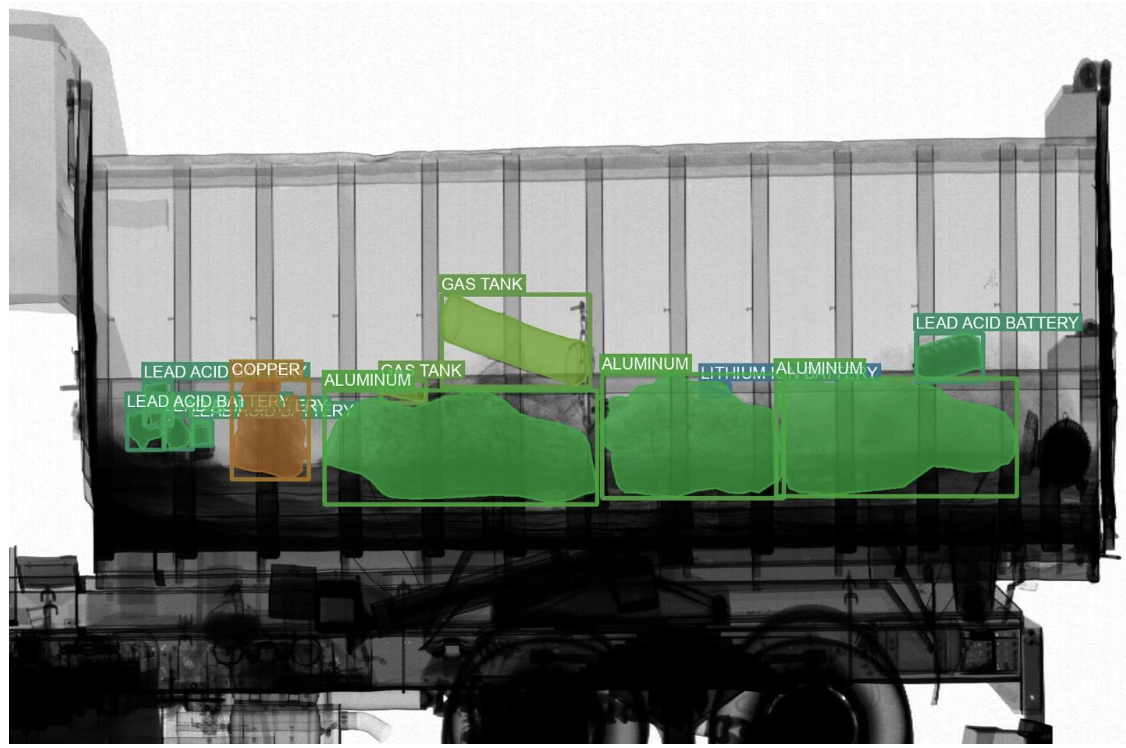
Another thing we do is scale X-rays, literally truck scanning systems. We aren’t just finding batteries; we’re understanding the composition of the load.
What contaminants do yards care about? Batteries are one issue but so are cement blocks, and even dirt can be a big problem. So, I think it’s an opportunity to create transparency at the scale and solve the fire problems.
Using advanced AI and imaging technology, we provide detailed data on material types, quantities, and composition. These reports can help track material flows and get real-time alerts for unusual trends, like a spike in certain material types so you can respond quickly to potential risks.
Our business has existed for about three years, we’re in 30 sites around the country and we’ve gotten to work with some of the largest recyclers out there.
Tell me about one of your success stories.
Rumpke was one of our first customers. After a battery fire destroyed its recycling facility, Rumpke needed a proactive solution to detect hazardous materials—especially lithium-ion batteries—before they caused thermal events.
Rumpke used our X-ray system on its pre-sort line. The system uses machine learning to automatically identify hazardous materials—like batteries and gas tanks—within seconds, even through dense piles of material. A mounted laser pointer alerts sorters to the exact location of flagged items for manual removal.
Rumpke’s operations team now accesses real-time material composition data through Visia’s dashboard, replacing manual audits with continuous insight. The system learns and improves over time, adapting to Rumpke’s evolving material stream.
We can’t afford to be inaccurate. We don’t claim to be 100 percent accurate, but we’d rather have a real 94 percent accuracy. That’s something we make a real effort to explain—these systems aren’t perfect; they won’t find every battery. But they will find a statistically significant portion of all of them.
Images courtesy of Visia.