
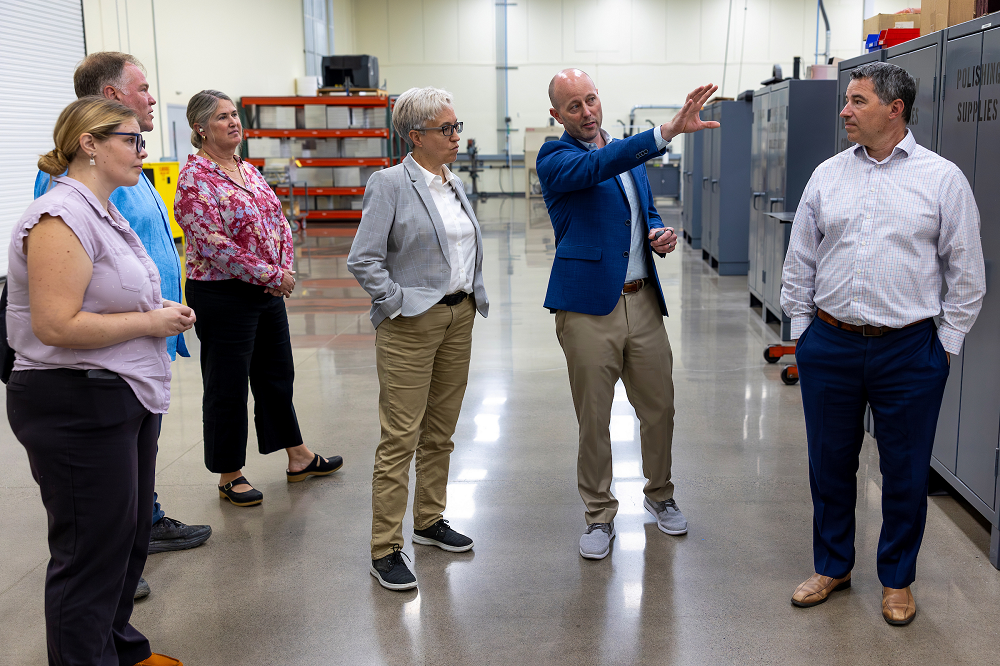
Governor Kotek Tours PakTech Headquarters, Highlighting Oregon’s Circular Economy Leadership
On Friday, August 1, PakTech, a global leader in sustainable secondary packaging solutions, welcomed Oregon Governor Tina Kotek to its Eugene headquarters this week, along with Paul Rainey of Gallatin Public Affairs and Courtney Flathers of the Governor’s South Valley Mid Coast Regional Solutions Team. The visit provided a behind-the-scenes look at how PakTech is helping drive innovation in Oregon’s circular economy.
According to Jonathan Levy, PakTech’s Manager of Sustainability and Public Policy, the tour came about because the company’s lobbyists were attending a National Governor’s Association meeting and reached out to Governor Kotek at the reception.
“We were able to show the Governor our sustainability efforts and how we support plastic recycling by using rHDPE in our products,” he said. “PakTech’s fully recyclable packaging handles made with recycled content are a great example of innovation in action, and show what can happen when a company works to find solutions to sustainability challenges. We’re showing what’s possible when sustainability is built into the entire packaging lifecycle—from design to recycling.”
The tour comes at a pivotal moment as Oregon advances implementation of the Recycling Modernization Act, a groundbreaking policy reshaping the state’s recycling infrastructure. According to PakTech, the company’s 100 percent recycled, and fully recyclable HDPE handles exemplify the innovation needed to meet these ambitious goals.
PakTech’s sustainable packaging highlights include:
- 100 percent recycled and 100 percent recyclable HDPE handles, certified by SCS Global Services;
- Recognized by the Association of Plastic Recyclers (APR) and the Recycling Materials Association (ReMA) as an acceptable material for reclaimers;
- Included in the HDPE Color Bottles Specification;
- Free of PFAS and other hazardous materials;
- Designated as a recyclable material in all Extended Producer Responsibility (EPR) states and;
- Developed a bio-derived black pigment compatible with optical sorting systems.
According to Levy, it’s a good idea for recyclers to invite policymakers and other decisionmakers to tour their facilities. Policy doesn’t happen in a vacuum, and policymakers often don’t make the connection about how their policy decisions could impact manufacturers and their work.
“By asking them to come and tour our facility we were able to show the connection between laws and regulations and those policy discussions. Often, they come away with a clearer understanding of how their actions impact the recycling industry,” he said. “We were also able to provide detailed knowledge and serve as a source of information for future discussions.”
As Oregon continues to lead the way in modernizing recycling, PakTech remains committed to innovating for impact—proving that scalable, sustainable solutions are not only possible, but already in action.