
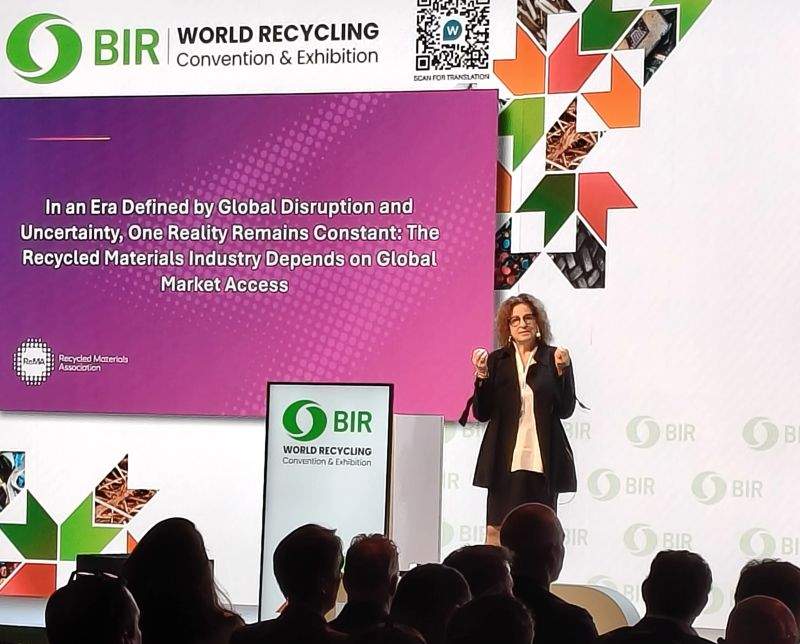
ReMA President Robin Wiener Elevates Importance of Market Access for Recycled Materials at BIR Gothenburg 2026
“In an era defined by global disruption and uncertainty, one reality remains constant: the recycled materials industry depends on global market access,” said ReMA President Robin Wiener in her remarks during the International Trade Council (ITC) Session at BIR Gothenburg 2026. The ITC session explored how the recycled materials industry can navigate global trade disruptions and stricter raw material regulations.
From June 1 to 3, Wiener, along with a delegation of ReMA leaders, members, and staff, are attending the Spring 2026 Bureau of International Recycling (BIR) Convention and Expo in Gothenburg, Sweden to engage on the critical global issues shaping the future of the recycled materials industry. Wiener’s presentation at the ITC session helped demonstrate ReMA’s leadership in international advocacy efforts including global trade, recycling markets, and resource security.
Wiener was joined by Fernando Acosta, Director of Economics and Environment at the International Copper Study Group, who discussed the strategic rise of secondary copper, and Mattias Rapaport, Managing Director of Stena Metal International at Stena Recycling, who shared practical commercial and operational strategies for today’s market. The session was moderated by Emmanuel Katrakis, Director of Public and Regulatory Affairs at the Belgin/French recycling firm Galloo.
Among the topics she covered were U.S. trade and tariff policies impacting global markets since January 2025 including the Section 232 tariffs, the Fentanyl-related tariffs, the Reciprocal tariffs, and the Section 301 tariffs.
“The policy environment is complex and evolving,” she said. “ReMA is actively engaged on all of these fronts, advocating for policies that keep recycled materials flowing and protect our trading relationships.”
When discussing marketing reactions since January 2025, Wiener noted that the U.S. recycled materials industry is dynamic and resilient. Recyclers adapted to policy uncertainty, the system absorbed shocks, and trade is returning to normal. The structural relationships behind this trade—geography, mill capacity, complementary capabilities—are still in place. This is a market adjusting, not breaking down.
Reflecting on her presentation Wiener said, “It was wonderful to have the opportunity to share the stage with Emmanuel Katrakis, Fernando Acosta, and Mattias Rapaport to discuss the critical importance of global market access for global manufacturing and supply chains, as well as the health of the recycled materials industry around the world.”